Narrow Seas Rules

1.0 Overview
Narrow Seas is a 30-minute, two-player Age-of-Sail duel on a compact board.
Each player commands two ships, secretly assigns Crew to Sail, Return to Duty, Lookout, and Fire. Players then alternate single-action turns to sail, fire cannons, and return injured crew to duty. Cards must match your ship’s hex. Time your draws from the market. Send both enemy ships to the bottom.
1.1 Background and Print-and-Play
Narrow Seas was conceived in early August 2025. Early drafts were constructed and played locally in Seattle, WA. On August 30, 2025, the game was entered into the 2025 Two Player Print and Play Game Design Contest. You can find Print-and-Play information at the contest link.
1.2 How to Win
A ship is sunk if it has 0 Crew on its ship card. You win by either:
- Sinking both opposing ships; or
- Mercy Victory (Lead by 4): If at the end of the round the difference between the players’ available Crew cubes (i.e. still on their ship cards) is 4 or more, the leading player wins immediately. (Example: you have 3 crew on your ship cards and your opponent has 7. The difference is 4. Your opponent is leading and wins.)
2.0 Components
- Game board (hex map)
- 22 Action cards (21 suit cards: 7 per suit; 1 neutral Wind card)
- Ship & crew tokens: Each player gets 2 ship tokens and 8 crew “cubes” (4 for each ship).
Note: Printable tokens are included with the PnP version of the game. But, small wooden cubes are recommended if you have them on hand. You’ll need 4 colors, 5 cubes in each color (1 to represent the ship and 4 for the ship’s crew). The actual color of the cubes does not matter; just that you have distinct colors so that you can link the ship on the map with the crew on its ship card. If you’re using the printable tokens, make note, I’ll still refer to them as “cubes” throughout the rules.
- 1 shared Sick Bay card
- 4 Ship cards (2 per player)
- Wind direction token.
- The wind token shows three labeled edges (Reach/Tack/Run) that indicate legal headings relative to wind.
- First Player marker
- 2 player aid cards
3.0 Setup
-
Place the board between players.
-
Shuffle all action cards to form the Draw Deck. Deal 3 face-up to create the Market.
-
Each player takes their two ship cards and matching-color crew cubes/tokens. For each ship: place 4 cubes on its ship card; keep 1 cube of that color beside the board to use as the ship marker.
-
Choose First Player. Randomly give one player the First Player marker.
- Ship placement (alternate placing ships, starting with the First Player).
- The first ship must be placed either at the edge of the board or one hex from the edge.
- After the first ship is placed: each newly placed ship (alternating players) must be no closer than 4 hexes to all enemy ships and must be exactly 4 hexes from at least one enemy ship.
- Second Player sets the wind direction (any direction of their choosing).
4.0 Anatomy of a Ship Card
A ship card has four planning areas and a spent area:
- Plan to Sail (
 )
- Plan to Return to Duty (
 )
- Plan to Lookout (
 )
- Plan to Fire (
 )
- Spent
Planning & costs. During the Planning Phase you may assign any number of Crew to any Plan areas. At the start of each Plan Phase, cubes in Spent become available again for assignment. When you take an action, move 1 Crew cube from the relevant Plan area to Spent. You may only take actions you planned.
Casualties. When you take casualties, move cubes from the ship to Sick Bay; they cannot be assigned until returned to duty.
5.0 Core Concepts
5.1 Suit Matching
- Suits: ♦ yellow, ● blue, ▲ red
- To play any Sail, Cannon, or Return to Duty card, its suit must match your ship’s hex.
6.0 Round Structure
Each round has four phases.
- Plan
- Draw
- Action
- Reset
6.1 Plan Phase
-
Secret planning: For each ship, take any cubes not in the Sick Bay - including cubes in Spent - and secretly assign them to Plan areas. You may briefly cover your ship cards with your forearm or hand while secretly planning.
-
You may only take actions you planned this round.
-
Open info outside Plan: During all other phases, ship cards are public; keep them visible to both players.
6.2 Draw Phase
- Determine First Player. The player with the most Crew in Plan to Lookout (across their ships) is First Player. Tie: the player holding the First Player marker. Move the marker there.
- First Player draws first, then alternate until each player has 6 cards. On your draw, either:
- Draw the top card of the Draw Deck, or
- Spend 1 Crew from Plan to Lookout (move that cube to Spent) to take any one card from the Market; immediately refill the Market from the deck.
- Continue alternating draws until one player has 6 cards. The other player may then continue until they have 6 cards as well.
Hand persistence: Hands carry over between rounds, except the Wind card; if it’s in your hand, discard it during Reset.
Reshuffle: If the Draw Deck empties at any time (draws or Market refills), shuffle the discard to form a new deck and continue.
6.3 Action Phase
Turns alternate, starting with the First Player. On your turn, choose one:
- Play a card (must meet its Requirements), or
- Discard a card, or
- Pass — if you pass, you may take no further actions this phase (including discards).
The phase ends when all players have passed or no cards remain to play.
Card lifespan: Unless a card says otherwise, after resolving its effect, discard it immediately.
6.4 Reset Phase
- Mercy Check: If the difference in available Crew on ship cards is ≥ 4, the leading player wins.
- Discard the Wind card from your hand: (Wind cannot be held between rounds.)
- Return any face-up action cards left in play to the discard.
- Discard the entire Market and deal a fresh 3-card Market.
7.0 Actions (Reference)
7.1 Sail — Reach / Tack / Run
Requirements
- Card matches the suit of the target ship’s hex.
- Target ship has a cube in Plan to Sail.
Procedure & Effects
- Move 1 Crew cube Plan to Sail → Spent.
- Move the ship per the card (token shows these headings):
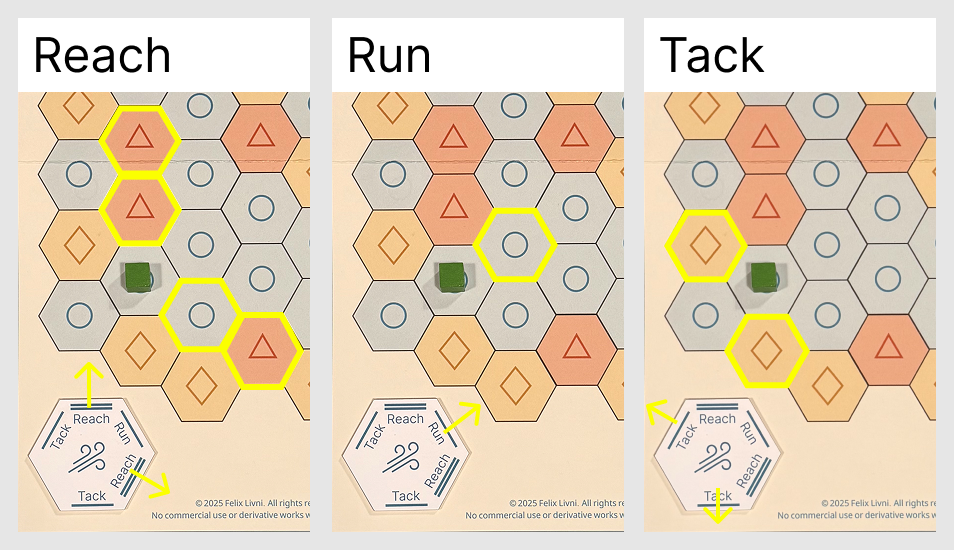
- Reach: move 1–2 hexes; each step may deviate up to 60° left/right of wind.
- Tack: move 1 hex about 120° left/right of wind.
- Run: move 1 hex with the wind.
Occupancy & Passing
- Two ship markers may never end in the same hex.
- When performing Reach for two steps, a ship may pass through an occupied hex on the first step, but it must end its movement in an empty hex. (Tack and Run are single-step and may not enter an occupied hex.)
Sail Examples
The image below highlights valid hexes where the green cube (i.e. ship) could be after playing a “blue reach”, “blue run”, or “blue tack” card.
7.2 Cannon (e.g., Broadside)
Requirements
- Attacking ship has a cube in Plan to Fire.
- Card matches the suit of the attacking ship’s hex.
- Exact range equals the card’s range.
Measuring range: Range is the minimum number of hex steps from the attacker’s hex to the target’s hex. Do not count the attacker’s hex; entering the target’s hex counts as 1. Intervening ships do not block; only exact range matters.
Cannon Card details
- Carronades — Range: exactly 1; Damage: 3
- Broadside — Range: exactly 2; Damage: 2
- Long Nines — Range: exactly 3; Damage: 1
Procedure & Effects
- Move 1 Crew cube Plan to Fire → Spent.
- Deal X Damage to the target ship: the defender moves X crew cubes from that ship (from Plan or Spent) to the shared Sick Bay card.
- If all Crew for that ship have been removed, it sinks (remove its ship marker).
7.3 Return to Duty
Requirements
- Ship has a cube in Plan to Return to Duty.
- Card matches the suit of your ship’s hex.
- Target: your ship. (No range.)
Procedure & Effects
- Move 1 Crew cube Plan to Return to Duty → Spent.
- Return 1 Crew to that ship (move 1 cube Sick Bay → Spent).
7.4 Wind card
Requirements
- No requirements.
Procedure & Effects
- Change the wind direction to any new direction.
Restriction
- You cannot hold the Wind card between rounds; discard it from hand during Reset.
8.0 Four-Player Rules (Playtesting)
The four-player mode is currently being playtested and may be adjusted.
The four-player game uses the same components and core rules as the two-player game, with these changes:
- Play is team vs. team:
- Player 1 (Green team): ships A, B
- Player 2 (Pink team): ships W, X
- Player 3 (Green team): ships C, D
- Player 4 (Pink team): ships Y, Z
-
Elimination + Team Victory: A player is eliminated when both of their ships are sunk. A team wins immediately when any one opposing player is eliminated.
-
There are two individual decks that are kept separate.
-
First Player Token (initiative + direction of play): Double-sided token:
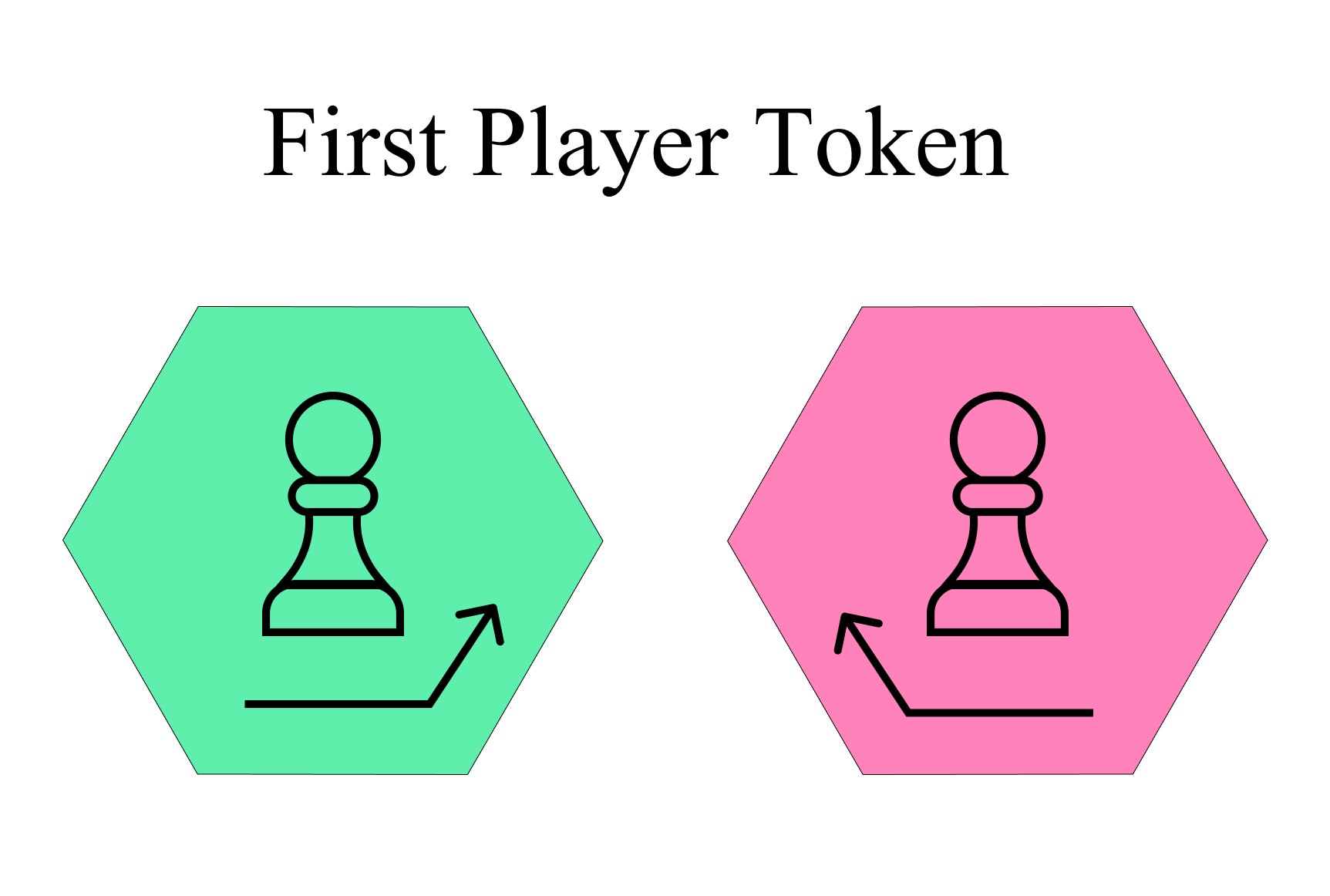
- Green side up: play flows counter-clockwise
- Pink side up: play flows clockwise
The token always sits with the First Player, and the face-up side always matches that player’s team color.
- First Player (each round): The First Player is the individual player with the most Crew placed on Lookout (sum across both of their ships).
- Tie: In the case of a tie, choose the new First Player starting with the current First Player and going in the current play-direction (determined by the First Player Token).
- Mercy Victory (Lead by 7): At the end of a round, if the difference between the teams’ available Crew cubes (cubes still on ship cards) is 7 or more, the leading team wins immediately.
- Board: The four-player game uses a larger, slightly different board. Starting positions are prescribed rather than chosen. (TODO: link / include.)
- Only a single wind card is in play at a time.
Unless a rule in Section 8 overrides it, follow the standard rules.
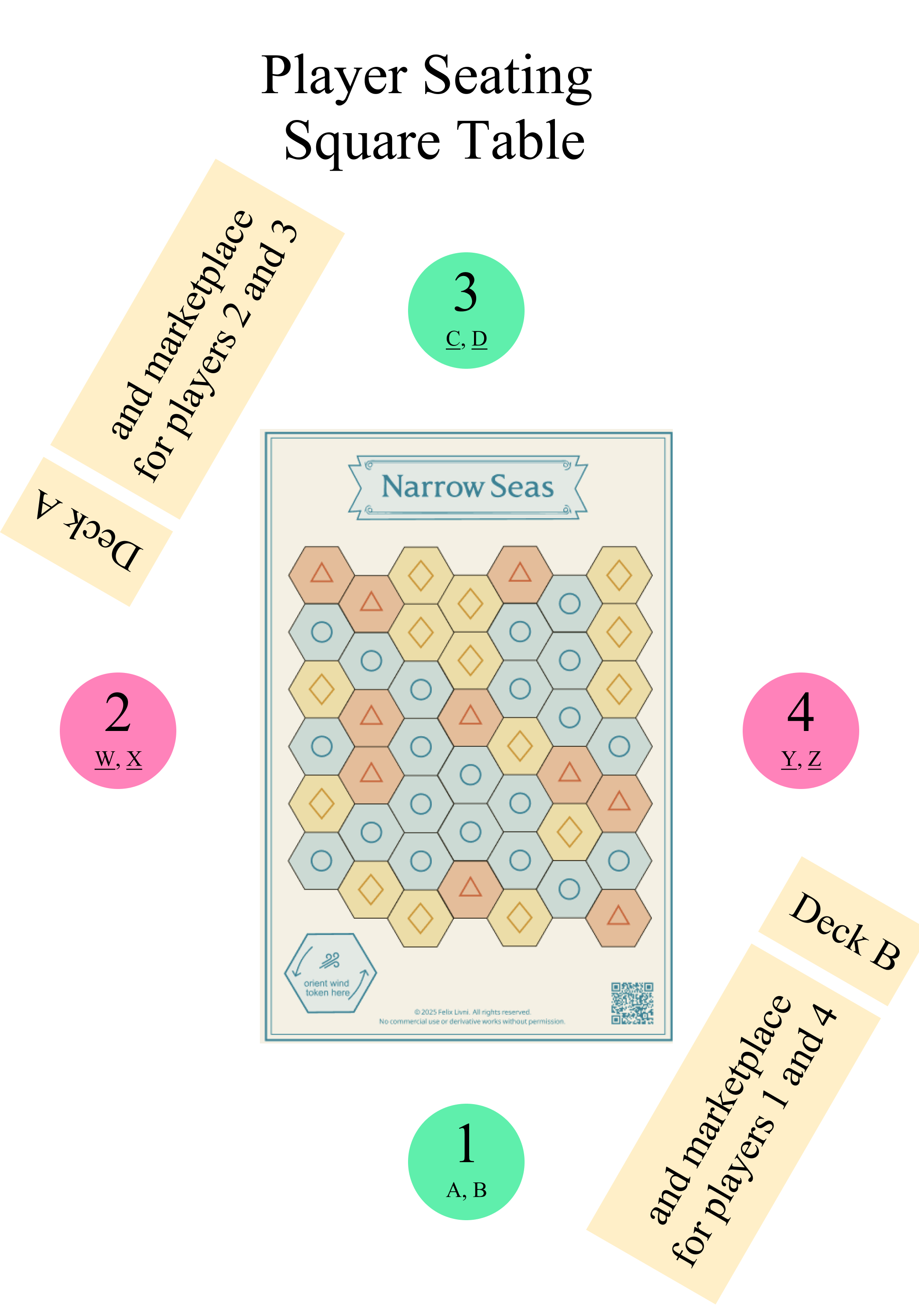
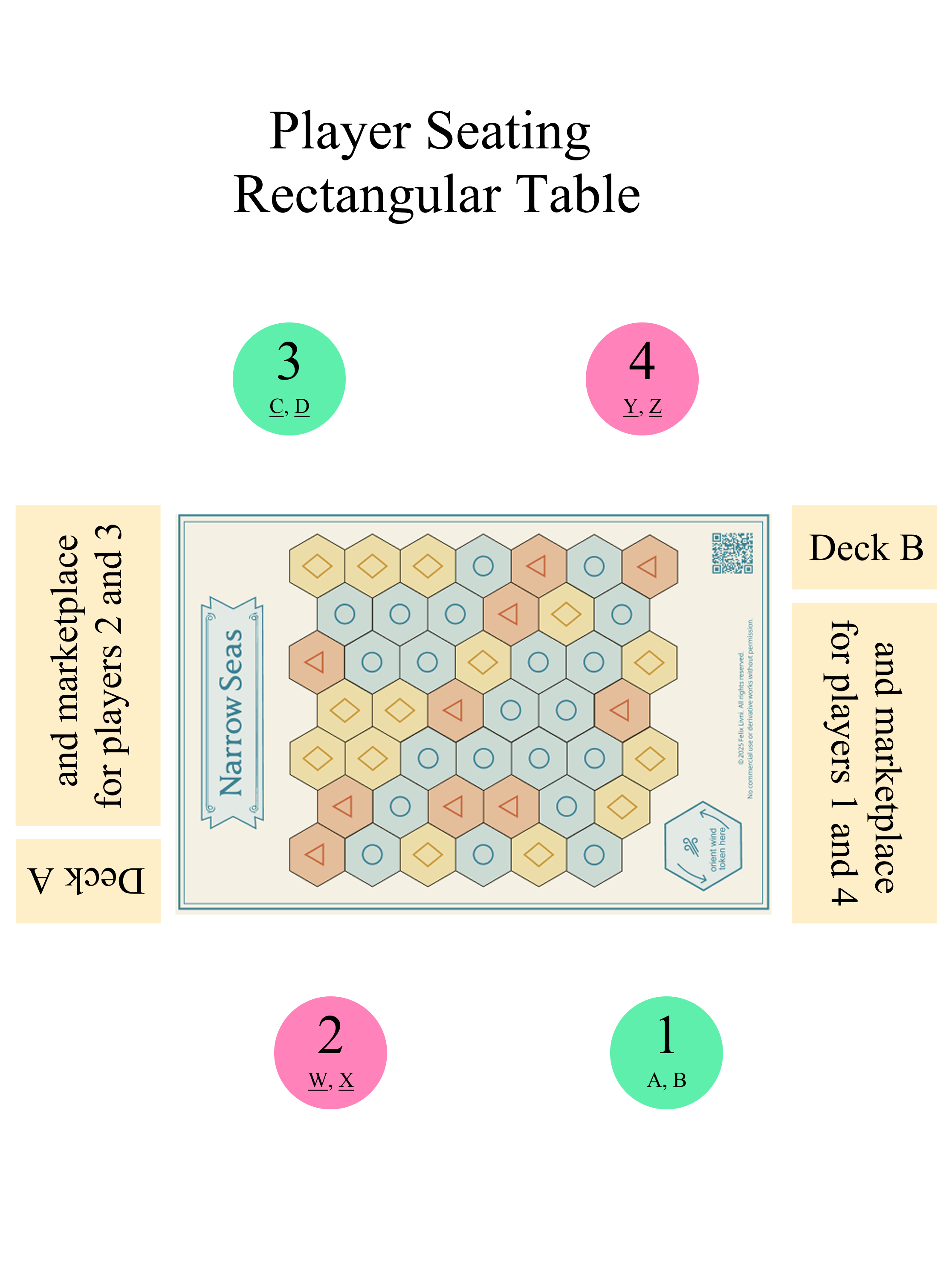
8.1 Seating
Seating is as in bridge: partners sit opposite each other.
- Green Team: Players 1 and 3
- Pink Team: Players 2 and 4
Square table seating
Rectangular table seating
8.2 Two Separate Decks (and two Markets)
Use two Narrow Seas decks and keep them separate (do not mix them).
- Deck A: shared by Players 2 and 3
- Deck B: shared by Players 1 and 4
Each deck has its own discard pile and its own Market (3 face-up cards). When you draw or take a card from the Market, you must use your assigned deck/Market.
All other card rules (hand size, reshuffle, etc.) are unchanged except Wind alternation (8.3).
8.3 Wind alternation (single Wind in circulation)
Wind alternates between decks so that only one Wind card is “live” at a time.
- During setup, remove Wind-A from Deck A and set it aside (out of play).
- Wind-B begins in Deck B as normal.
Whenever the live Wind card is played or discarded:
- Set aside that Wind card (remove it from play).
- Take the other Wind card (the one currently set aside) and put it into its deck’s discard pile.
This causes Wind to alternate between Deck A and Deck B over time.
8.4 Setup (Changes Only)
Follow Setup in Section 3.0, with these changes:
- Remove the Wind Card from Deck A.
- Shuffle both decks. (Remember to keep them separate.)
- Set up two Markets, one for each deck (3 face-up cards each).
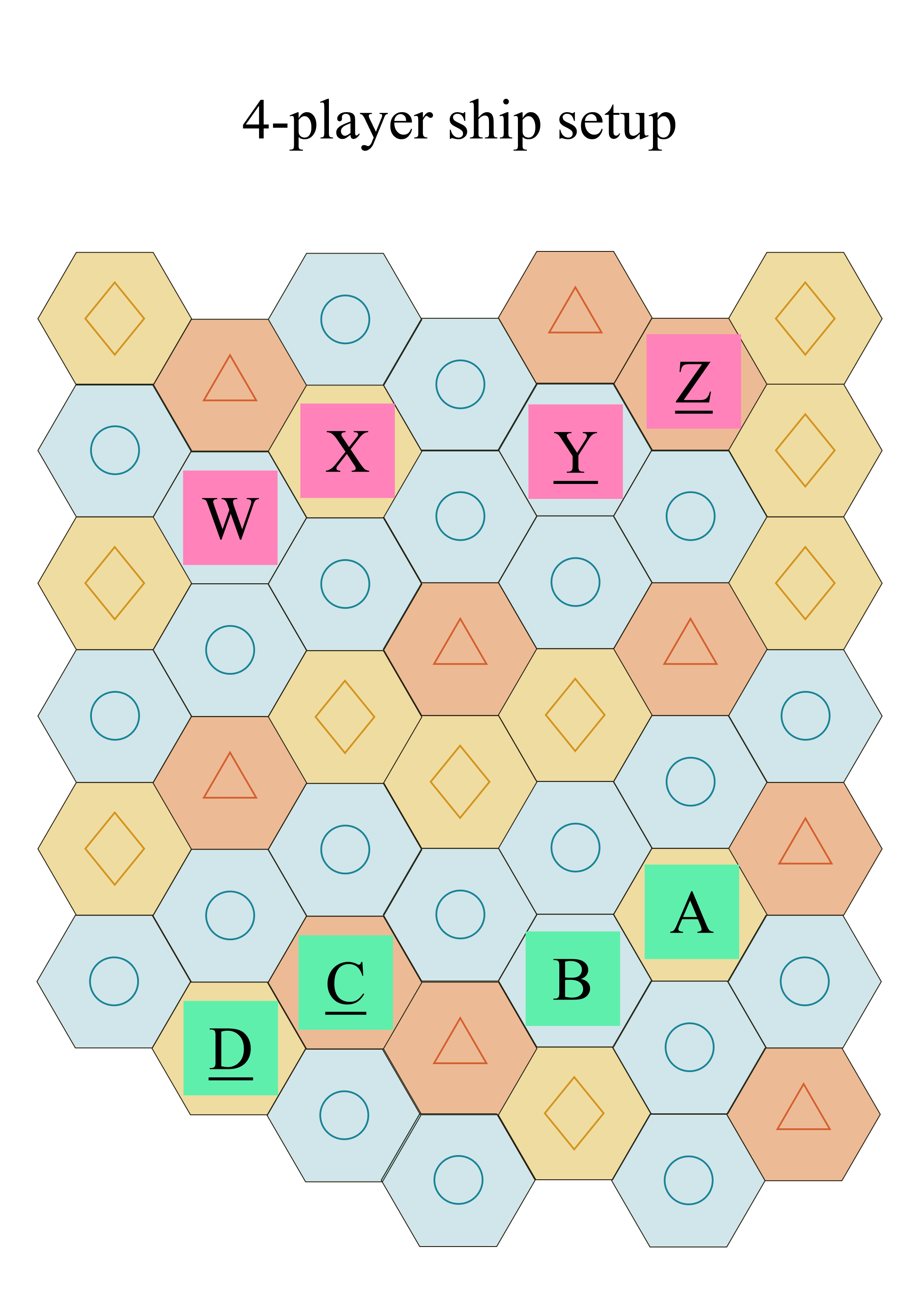
- Place the ship tokens as depicted in the image below (ignore the two-player ship placement rules).
- After ships are placed, Player 4 sets the initial wind direction.
- Give the First Player Token to Player 1 (Green side up).
8.5 Four-Player Turn Order (Round Flow Override)
In four-player mode, Draw Phase and Action Phase proceed around the table in the direction shown by the First Player Token.
-
Draw Phase: starting with First Player and proceeding in direction, players take draws until everyone has 6 cards (using their assigned deck/Market as normal).
-
Action Phase: starting with First Player and proceeding in direction, players take single-action turns as normal. Passing works as in 2-player (if you pass, you take no further actions this phase).
8.6 Team Victory
Players win as a team rather than individually.
- Sinking both ships of any single player; or
- Mercy Victory (Lead by 7): If at the end of the round the difference between the total available Crew cubes per team (i.e. still on their ship cards) is 7 or more, the leading team wins immediately. (Example: The Green Team has a combined crew of 13 and Pink Team has a combined crew of 6. The difference is 7. The Green Team is leading and wins.)
© 2025 Felix Livni. All rights reserved.
Personal PnP license: you may download, print, and share the unmodified PDFs for personal use and contest playtesting.
No commercial use or derivative works without permission.
Last updated: 2026-01-04